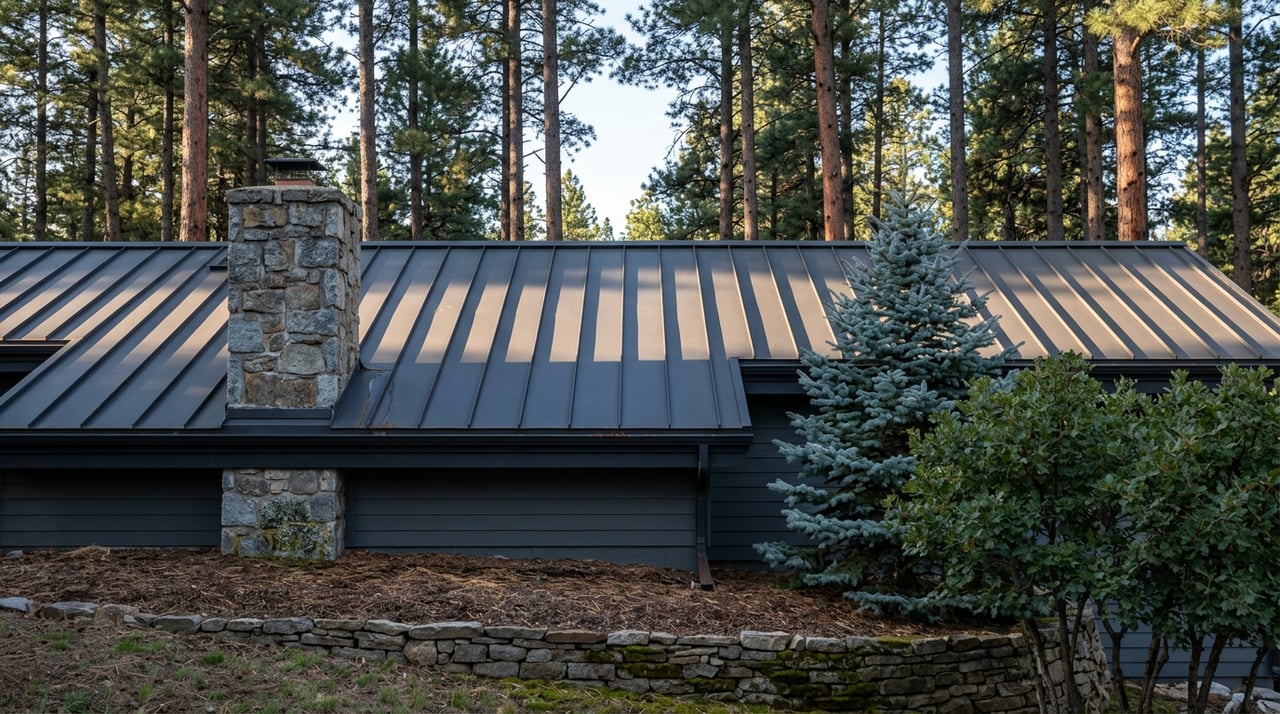
Say you're getting ready to list a house in Genesee this fall. The roof is 18 years old, a little tired-looking in photos, and your agent suggests a fresh one before you go on the market. You call a contractor, get a bid for a straightforward reroof, and figure it's a two-week job before your listing photos go live.
Here's the code trigger to check before finalizing a bid: as of July 1, 2026, Jefferson County's new Wildfire Resiliency Code means that once you replace 25 percent or more of your existing roof covering, the code treats the entire roof as new construction. Not just the shingles you're swapping out. The whole assembly, held to the same standard as a home being built from scratch. The same 25 percent rule applies to exterior walls. Reside a quarter of your house, and the code requires the entire wall surface, including trim and attachments, to meet new-construction material standards.
That makes it important to account for the code requirements when planning the scope.
Why a "small" pre-listing project rarely stays small
A full reroof is, almost by definition, more than 25 percent of the roof. So is a full re-side. These are exactly the projects sellers do to freshen curb appeal before listing, and they are exactly the projects that flip a home from "existing structure, grandfathered as-is" into "must meet current code" under Jefferson County's rules.
The county's own code language spells out the mechanics plainly: additions or alterations can be made to an existing structure without triggering full compliance, provided the work stays under specific thresholds. Cross them, and the addition or alteration has to conform to what's required for new construction. The thresholds that matter most for a seller are:
| Project | The line that changes everything | What crossing it requires |
|---|---|---|
| Reroof | 25% or more of existing roof covering replaced | Entire roof must meet Class A fire rating and current ember-protection standards |
| Re-side | 25% or more of exterior wall surface replaced | Entire wall surface, including attachments, must meet current structure-hardening material standards |
| Addition or deck rebuild | Adds 500 square feet or more to the footprint | The added portion is treated as new construction under the full code |
A patch job, a partial repair under 25 percent, or simple painting and staining stays exempt. But sellers rarely do partial reroofs before listing. They do full ones, because a half-replaced roof photographs worse than the tired original.
This isn't a fringe rule out here
Jefferson County has one of the highest wildfire risk profiles in the country. More than two-thirds of the county sits inside a designated Wildfire Hazard Overlay District, and the county ranks first in Colorado for the number of homes located in high and extreme wildfire risk areas. That's the backdrop the Board of County Commissioners cited when they approved the updated Wildfire Resiliency Code on March 10, 2026, ahead of the state's July 1 enforcement deadline.
As The Denver Gazette reported, Commissioner Lesley Dahlkemper said the county needed to "think differently about how we build" as the update passed, pointing to record-low snowpack and unseasonably high temperatures as part of the urgency behind the change.
Genesee sits inside unincorporated Jefferson County, in the foothills terrain the code was written for. If you're planning renovation work before a listing, the responsible first step isn't guessing whether your parcel falls inside the mapped Wildland-Urban Interface. It's checking the county's interactive WUI map for your specific address before you sign a bid, because the boundary shifted with this update and some properties that weren't covered before are now inside it.
How the 2024 law changed material rules
In some of Colorado's mountain communities, design covenants favored a particular aesthetic, sometimes one that excluded the noncombustible siding or Class A roofing a homeowner wanted to install.
That changed in March 2024, when Colorado signed HB24-1091 into law. The bill generally prohibits covenants and other restrictions that disallow the installation, use, or maintenance of fire-hardened building materials in common interest communities. In practice, that means Genesee's Architectural Review Committee, the body that meets twice monthly to review modification and renovation applications, can no longer reject a compliant, fire-resistant material on aesthetic grounds alone.
That's a genuine shift for a community that has leaned into fire preparedness for a long time. Genesee was one of the first communities to join the Firewise Communities Program, and its Ecosystem Management Committee guides wildfire and weed mitigation across roughly 1,200 acres of shared open space. Genesee Fire Rescue, for its part, has worked directly with HOA leadership to update design requirements with wildfire in mind. The HOA and the fire district have been rowing in the same direction here for years. The 2024 law just removed a legal gap that used to sit between covenant enforcement and code compliance.
Not the certification you may have heard about
If you've read anything about Colorado, wildfire, and home sales, you may be thinking of a different proposal: a 2024 bill that would have required Jefferson County and eleven other high-risk counties to create a point-of-sale wildfire mitigation certification program, essentially a wildfire inspection tied to closing, similar to how some counties handle septic transfer inspections. That bill, HB24-1300, passed the House but was postponed indefinitely by a Senate committee in April 2024. It never became law.
So there is no state or county requirement today that ties a wildfire certification to the sale itself. What's actually in effect is narrower and, in a way, more relevant to a seller doing pre-listing work: the Wildfire Resiliency Code that governs permitted construction, triggered by the renovation, not the transaction. Selling an untouched home doesn't require anything under this code. Pulling a permit for a reroof, re-side, or addition does.
What this means if you're listing this fall or next spring
The fix here isn't complicated, but it has to happen before you sign a contract, not after the crew shows up. Ask your contractor directly whether the scope of work crosses the 25 percent threshold on roof or walls, or the 500 square foot mark on any addition. If it does, get the compliant-material quote up front. Jefferson County separates the review into two tracks: structure hardening gets checked through the standard building permit process, while defensible space, the cleared zone around the structure, is typically verified by a county-approved Wildfire Mitigation Specialist before final sign-off. Some re-siding projects qualify for a homeowner self-certification of the immediate five-foot zone instead of a specialist inspection, which can save a step, but it's worth confirming which path applies to your project before you assume either way.
None of this is insurance advice, and the Wildfire Resiliency Code itself is a building and land-use regulation, not an insurance mandate. But insurers across Colorado are paying closer attention to mitigation and hardening when they evaluate properties, so a compliant roof or siding job done now may carry value beyond the sale itself, even if it isn't guaranteed to move the needle on any specific policy.
FAQ
Does this code apply if I'm not renovating before I sell? No. The code is not retroactive. A home that's been standing as-is continues as-is. It only applies once you pull a permit for covered work.
What if I only need a small patch repair? Repairs affecting less than 25 percent of the roof or wall surface, along with routine painting, staining, and similar maintenance, are exempt from the new-construction standard.
Does the HOA still have a say in what materials I use? Genesee's Architectural Review Committee still reviews applications for modifications and additions, but under the 2024 state law, it can't block a fire-hardened material solely because it doesn't match the community's traditional aesthetic.
Will I need a wildfire certification to close on my home? Not currently. The 2024 proposal that would have created a point-of-sale certification requirement in Jefferson County was postponed indefinitely and never became law. What's active today is the permit-triggered building code described above, which is a separate mechanism entirely.
How do I find out if my project crosses the threshold? Jefferson County's Planning and Zoning division maintains the interactive WUI map and the current Wildfire Resiliency Code documentation. Confirming your parcel's classification before you finalize a renovation bid is the single most useful thing you can do here.
If you're weighing whether a pre-listing renovation in Genesee is worth the added scope, or whether it makes more sense to price the home as-is and let a buyer factor in the roof, that's exactly the kind of sequencing conversation worth having before contracts get signed, not after. Chad Goodale works Genesee and the surrounding foothills regularly and can walk through the numbers with you before you commit to a renovation budget.
This article is general information, not legal, tax or financial advice. Consult a qualified professional about your situation.